
Last Updated: October 25, 2026
Quick Summary
Choosing a wedding officiant and DJ requires booking them as a coordinated team rather than separate vendors. Your officiant and DJ must communicate on timing, music cues, and announcements to ensure your ceremony flows smoothly into your reception. Book your officiant first, then your DJ, and schedule a joint coordination call at least 4 to 6 weeks before the wedding to align on your vision.
- Book the officiant 10 to 9 months out, then the DJ 9 to 8 months out, since officiants have less availability.
- According to The Knot Worldwide 2026 Real Wedding Study, 53% of couples said personality was a top deciding factor when hiring a DJ.
- Hold a joint coordination call 4 to 6 weeks before the wedding so your officiant and DJ can sync on ceremony cues and microphone handoff.
- Ask your DJ about backup equipment and whether they have a substitute available if they become unavailable on your wedding day.
- Send a final run of show document 2 weeks before the wedding with processional, recessional, readings, and reception timeline to both vendors.
Table of Contents
- Why Your Officiant and DJ Matter More as a Team
- Step 1: Clarify Your Ceremony Style and Values
- Step 2: Ask the Right Questions to a Wedding Officiant
- Step 3: Ask the Right Questions to a Wedding DJ
- Step 4: Plan Your Wedding DJ Booking Timeline
- Step 5: Coordinate Wedding Ceremony Music Cues with Your DJ
- Step 6: Evaluate Contracts, Backup Plans, and Day-of Coordination
- Step 7: Book Your Coordinated Team and Lock in Your Vision
- Frequently Asked Questions
Why Your Officiant and DJ Matter More as a Team
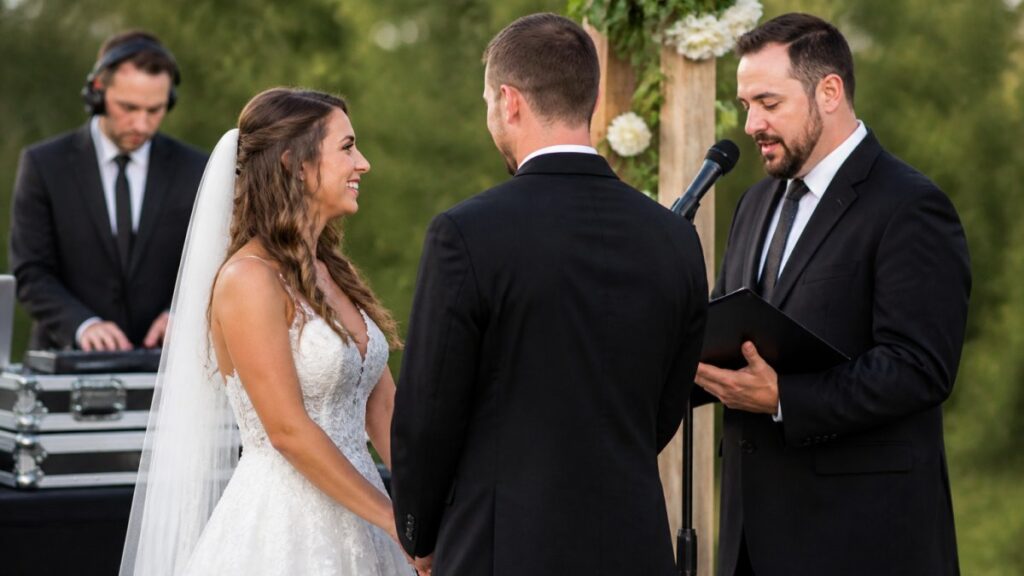
Your wedding officiant and DJ aren’t just two separate vendors. They’re the backbone of your ceremony and reception flow. When they work together, your day moves smoothly.
According to The Knot Worldwide 2026 Real Wedding Study, 53% of couples hiring a DJ said personality was a top deciding factor. But personality alone isn’t enough. Your officiant and DJ need to coordinate on timing, music cues, announcements, and tone.
At 1021 Events, we understand how a coordinated team transforms a wedding.
This guide walks you through choosing both vendors as a unified team: what to ask, when to book, and how to align them on your vision before the ceremony starts.
Step 1: Clarify Your Ceremony Style and Values
Before you contact a single officiant or DJ, get clear on what your ceremony actually looks like: religious or secular, formal or casual, 15 minutes or 45. Your answers shape everything that follows.

Your ceremony style determines the type of officiant you need.
Your values matter equally. Some couples want their officiant to weave their story throughout; others want tradition and structure. Some want their DJ to MC and guide the flow; others prefer minimal announcements.
Ask yourself these questions now:
- Religious ceremony, nonreligious ceremony, or blend of both?
- Formal and traditional, or casual and modern?
- How much personalization do you want in your ceremony script?
- Do you want your DJ to MC announcements, or stay in the background?
- What’s your music style: classical, contemporary, eclectic?
Write your answers down. You’ll reference them when interviewing candidates.
Step 2: Ask the Right Questions to a Wedding Officiant
Finding the right officiant starts with the right questions. You’re not just checking availability. You’re assessing whether they understand your vision and can deliver it with confidence.
Next, dig into their approach to ceremony writing. Do they write a custom script or use a template? How much input do they want?
Public speaking matters. Ask how they handle nerves and project their voice.
Finally, ask about coordination experience. Have they worked with DJs before? Will they meet with your DJ before the wedding to sync on timing, music cues, and transitions?
You can find and vet officiant candidates using resources to find your wedding ceremony officiant.
Step 3: Ask the Right Questions to a Wedding DJ
Music planning is critical. Ask how they build a playlist: do they meet with you, take requests, and handle songs you want to avoid?
Ask about equipment and backup. What happens if their main system fails? Do they have backup speakers, microphones, and music sources?
Finally, ask about ceremony coordination. Have they worked with officiants before? Use how to choose a wedding DJ: expert tips & key questions to review detailed questions and evaluation criteria.
You can find detailed questions and evaluation criteria using how to choose a wedding DJ with expert tips.
Step 4: Plan Your Wedding DJ Booking Timeline
Timing matters when booking your officiant and DJ.
12 to 10 months out: set the date and the ceremony time. Your ceremony start time is the single fact both vendors build around. Until you have it, no officiant can confirm availability and no DJ can quote ceremony coverage. Lock the date and a target start time before you make a single inquiry.
10 to 9 months out: book the officiant. Officiants are the bottleneck, clergy, courthouse-adjacent officiants, and popular celebrants may take only one or two weddings per weekend, and holiday weekends fill first. Peak-season Saturdays from May through October are tightest. Expect to sign and pay a deposit at booking; many collect a retainer of roughly a third to half the fee, with the balance due closer to the date. Ask what the deposit covers and whether it’s refundable.
9 to 8 months out: book the DJ. Once the officiant is confirmed, you know the ceremony time, typical ceremony length, and whether they’ll handle their own microphone, exactly what a DJ needs to quote ceremony versus reception-only coverage. DJs are generally more available than officiants, but the best ones book peak Saturdays early, so don’t treat this as a slack step.
6 months out: confirm both contracts and the deposit schedule. Re-read both agreements side by side. Confirm arrival times, the venue’s load-in window, and whether either vendor charges for travel beyond a set radius. Travel fees and overtime rates are the two line items most often discovered late.
4 to 6 weeks out: hold the joint coordination call. The officiant and DJ meet by video or in person to walk the ceremony cue sheet, confirm microphone handoff, and agree on who signals what. Put it on the calendar at booking, not later, calendars fill.
1 week out: confirm arrival times and equipment. A short email confirming who arrives when, what each vendor brings, and the on-site contact number closes the loop.
A few practical notes on the order. Use a wedding planning timeline: your month-by-month guide to organize your officiant and DJ bookings alongside other vendor decisions.
A month-by-month wedding planning timeline helps you slot these bookings and meetings into the right sequence.
Follow this timeline to book your officiant and DJ in the right sequence, ensuring both vendors have the information they need to coordinate effectively.
| Timeline | Action | Key Detail |
|---|---|---|
| 12 to 10 months out | Set date and ceremony time | Both vendors build around ceremony start time |
| 10 to 9 months out | Book officiant | Bottleneck vendor; expect deposit of one-third to one-half fee |
| 9 to 8 months out | Book DJ | More available than officiant; best ones book peak Saturdays early |
| 6 months out | Confirm contracts and deposits | Review both agreements side by side for conflicts |
| 4 to 6 weeks out | Hold joint coordination call | Officiant and DJ sync on ceremony cues and microphone handoff |
| 2 weeks out | Send final run of show | One document with processional, recessional, readings, timeline |
| 1 week out | Confirm arrival times and equipment | Confirm who arrives when and on-site contact number |
Step 5: Coordinate Wedding Ceremony Music Cues with Your DJ
Your ceremony music sets the tone for everything that follows. Processional, recessional, and any background music during vows or readings must be coordinated between your officiant and DJ.
Start with your processional music, the song your wedding party walks down the aisle to. Match it to your ceremony style: classical for formal, contemporary for casual, upbeat for fun.
Your recessional music plays as you and your new spouse walk back down the aisle together, typically faster and more celebratory than the processional. Again, your DJ needs the exact song and timing.
If you’re having readings or special moments, your officiant and DJ should coordinate background music. Some couples want soft instrumentals during vows; others want silence.
Create a simple ceremony music timeline and share it with both vendors at least 2 weeks before the wedding:
- Processional song (and duration)
- Background music during readings (if any)
- Recessional song (and duration)
- First song for the reception (timing of when DJ takes over)
Learn more about ceremony processional music options and coordination.
Step 6: Evaluate Contracts, Backup Plans, and Day-of Coordination
Before you sign anything, read both contracts side by side.
Payment schedule and overtime. Note the deposit amount, the balance due date, and the overtime rate.
Travel and load-in fees. Confirm the radius included in the base fee and the per-mile charge beyond it.
Cancellation and postponement. Read the cancellation clause for both vendors.
Substitution and backup. This is the clause most couples skip.
Equipment failure. Ask what redundancy is on site: backup speakers, a spare wireless microphone, and a second playback device.
Day-of coordination. Someone has to cue the processional, signal the recessional, and manage the handoff from ceremony to reception.
Use a wedding day coordination checklist to manage vendor timing, ceremony cues, and reception flow.
Step 7: Book Your Coordinated Team and Lock in Your Vision
Once you’ve interviewed candidates and asked the right questions, it’s time to commit. Book your officiant first, then your DJ.
After booking, schedule that coordination meeting, non-negotiable. Your officiant and DJ need to sync on ceremony music, timing, announcements, and any special requests.
Create a shared document or email chain that includes both vendors, your wedding planner (if you have one), and anyone else managing the day. Include:
- Exact ceremony start time
- Processional and recessional music selections
- Any special moments or readings with music cues
- Reception timeline (when toasts happen, first dance, etc.)
- Contact information for all vendors
- Day-of coordinator or point person for questions
Your officiant and DJ should feel like partners, not strangers. When they’re coordinated and aligned on your vision, your guests feel it. Your day flows.
At 1021 Events, we handle this coordination for you. Our team works as one unified unit: DJ, MC, officiant, lighting, photography, and videography all coordinated seamlessly.
The difference between a good wedding and a great one often comes down to this: vendors who communicate, coordinate, and work toward the same goal.
Frequently Asked Questions
How far in advance should you book a wedding DJ and officiant?
Book your wedding DJ and officiant 6-12 months before your wedding date, especially if you’re planning a peak season event (May-October). Top vendors fill quickly during popular months. Booking early also gives you time to coordinate their roles and ensure they understand your ceremony-to-reception flow. If you’re planning a smaller or off-season wedding, 3-6 months ahead is typically sufficient, but earlier is always better for peace of mind.
What questions should you ask a wedding officiant before hiring them?
Ask about their experience with your ceremony style (religious, nonreligious, or blended), whether they personalize the ceremony script, their comfort level with public speaking and pacing, their availability on your date, cancellation policies, and how they’ll coordinate with your DJ on timing and microphone use. Also ask for references from past couples and clarify all fees upfront. A strong officiant will ask you questions too, about your story, values, and what matters most in your ceremony.
Can a wedding DJ also serve as the MC and coordinate the ceremony-to-reception transition?
Yes, many professional DJs are trained to serve as MC and coordinate the full day’s flow. This integrated approach is often smoother because one person manages announcements, music timing, and transitions from ceremony to reception. However, confirm that your DJ has experience as an MC, understands your ceremony style, and will work closely with your officiant on microphone sharing, processional music, and reception timeline. A coordinated team prevents awkward gaps and ensures consistent pacing throughout your celebration.
What should you include in a wedding DJ and officiant contract?
Your contract should cover the date, time, and location; specific services (ceremony music, reception entertainment, MC duties, officiating); payment terms and any deposits; cancellation and rescheduling policies; backup plans if the primary vendor is unavailable; what happens if the event runs late; equipment provided; and how the DJ and officiant will coordinate on the day. Get everything in writing to avoid misunderstandings. Ask about their refund policy if you’re unhappy with their service, and clarify who is responsible for sound equipment and microphone management.
Choosing your wedding officiant and DJ is one of the biggest decisions you’ll make for your celebration. Get this right, and your entire day flows with confidence and joy. Start with clarity on your ceremony style and values, ask the right questions, and insist on coordination between both vendors. When your officiant and DJ work as a team, you’re not just hiring two people. You’re investing in a polished, memorable celebration that reflects your unique story.
